The U.S. Forest Service is proposing the 4,401-acre Bear Palmer “Forest Health” Project — including 2,126 acres of commercial logging (824 of them clear-cut) — in the forests surrounding Jardine, Montana, on the doorstep of Yellowstone National Park.
Why this matters: On May 5, 2026, the U.S. Forest Service withdrew the 19,921-acre Cooke City Fuels Project on this same national forest after conservation groups successfully challenged it in federal court. Public pressure on Bear Palmer can work too.
The Custer Gallatin National Forest's Gardiner Ranger District has proposed the Bear Palmer Forest Health Project (USFS Project #68985), a treatment plan covering approximately 4,401 acres in the drainages around Jardine, MT — including Eagle Creek, Bear Creek, Palmer Creek, and Crevice Creek.
Of that total, 2,126 acres are commercial timber harvest: 824 acres of clearcut, 802 acres of commercial thinning, and 500 acres of group selection. The remaining acres are non-commercial fuels, aspen enhancement, whitebark pine, and prescribed fire treatments. The project also proposes 16.9 miles of temporary roads (7.7 miles newly constructed) and includes 796 acres within the North Absaroka Inventoried Roadless Area.
The project is being fast-tracked under the Emergency Action Determination authority of Section 40807 of the 2021 Infrastructure Investment and Jobs Act. Under this authority, the USFS has explicitly stated there will be no administrative review, objection, or appeal process. The public comment period ran from April 10 to June 1, 2026 — the only opportunity for the public to weigh in. The Forest Service is now reviewing comments and preparing its decision.
The stated goals are "forest health," wildfire risk reduction, and insect/disease mitigation. But community members have serious questions about whether large clearcuts, 500 acres of group-selection regeneration, and miles of new temporary roads actually achieve those goals — or whether "forest health" is being used to justify commercial harvest in beloved local drainages.
At a public meeting on January 14, 2026, the USFS presented updated treatment maps showing that most areas previously marked for non-commercial treatment had been reclassified as commercial harvest zones. This shift, combined with the emergency designation removing any appeal process, has heightened community concern.
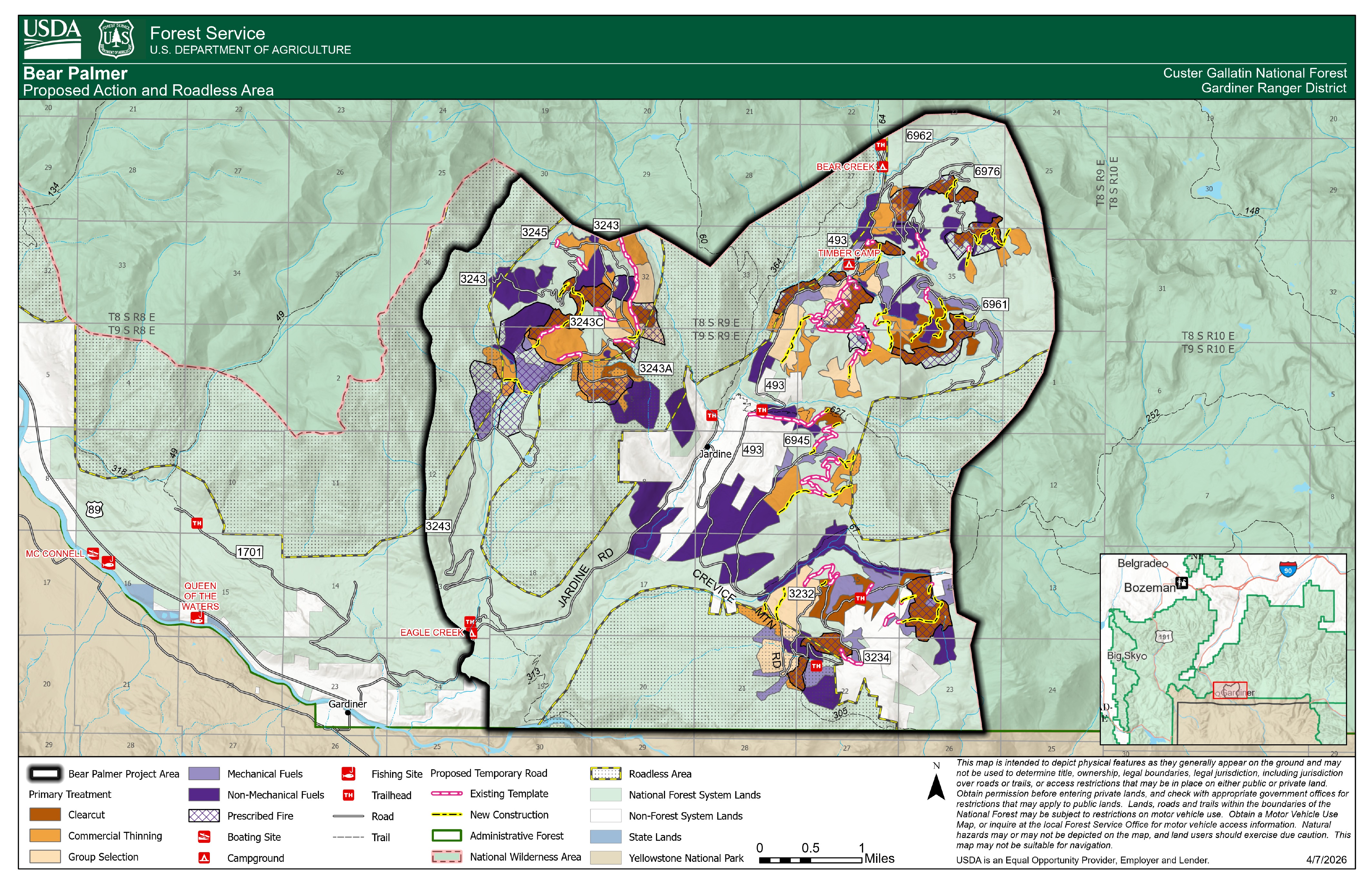
This is the official USFS map released April 10, 2026, showing the Bear Palmer project area. Click the map to zoom in and explore the full legend. Source: USDA Forest Service, April 2026 Preliminary Effects Document.
Source: USDA Forest Service, Custer Gallatin National Forest, Gardiner Ranger District — Bear Palmer Forest Health Project, April 10, 2026 Preliminary Effects Document. Download full document (PDF).
Aerial footage of the drainages and terrain inside the proposed Bear Palmer treatment area — on the Custer Gallatin National Forest, directly north of Yellowstone National Park.
Watch and subscribe on YouTube: @NoLogginginJardine
Residents and community members have raised significant concerns across four key areas. These are drawn from a formal response submitted to the USFS Gardiner District following the January 2026 public meeting.
We understand our forests face disease from pine beetle and spruce budworm, worsened by a changing climate. But clear-cutting large areas does not improve forest health — it removes the forest entirely, failing to distinguish between weaker trees and those that may be more resistant and resilient.
Reducing fire risk is cited as a primary justification, but the science doesn't support the approach being proposed.
Most areas originally marked for non-commercial treatment have been reclassified as commercial harvest, contradicting the stated intent of "forest restoration."
Eagle Creek, Bear Creek, Palmer Creek, and Crevice Creek are beloved recreation areas for Gardiner, Mammoth, and Jardine residents — the same drainages targeted for logging. The USFS acknowledges the project overlaps Pine Creek Trail 627, the Bear Creek winter ski trail system, a campground, trailheads, and outfitter/guide special-use permits.
The Forest Service is reviewing comments and finalizing the Environmental Assessment, after which Gardiner District Ranger Clint Kolarich will issue a decision. The agency has indicated it does not anticipate preparing a full Environmental Impact Statement. With no appeal process, independent and legal scrutiny is the remaining check — and on this same forest, that scrutiny recently reversed the SPLAT decision and forced withdrawal of the Cooke City project. We’ll post updates here and on social media as the decision develops.
The USFS released the Preliminary Effects Document on April 10, 2026, opening a 30-day comment period later extended through June 1, 2026. Because of the IIJA Section 40807 emergency designation, this was the only opportunity for public input — there is no objection or appeal phase. The Bear Creek Council, allied conservation groups, hundreds of residents, and commenters reached through national coverage submitted comments. Read the comments we submitted →
The Bear Creek Council submitted a formal response outlining concerns about forest health claims, fire risk justifications, treatment methods, recreation impacts, and the shift toward commercial harvesting. Regional press coverage followed in the Billings Gazette and Bozeman Daily Chronicle.
The Gardiner District held a public meeting presenting updated treatment maps, tree survey results confirming significant insect/disease pressure, and proposed treatment methods. Nearly 100 community members attended. The updated maps showed most areas previously marked for non-commercial treatment reclassified as commercial harvest.
The Secretary of Agriculture designated lands in the project area under the Emergency Action Determination authority of Section 40807 of the 2021 Infrastructure Investment and Jobs Act. This designation eliminates the normal objection and appeal process that would otherwise apply to the Environmental Assessment.
Recent coverage, press releases, and public updates related to the proposed Jardine logging project.
The comment period closed June 1, 2026. Because of the IIJA emergency designation, there are no appeals or objections after the decision — so staying informed and keeping the pressure on matters more than ever. Here's how you can help now.
Our 24-point comment letter to the Forest Service lays out the full case against the project — the emergency-authority objection, the clearcut justification, and the overlooked impacts to grizzlies, lynx, water, and the local economy. It’s the clearest summary of what’s at stake.
Read the Full Comments →Photos, videos, and updates from the project area — on the doorstep of Yellowstone. Follow along and share as we await the Forest Service’s decision.
Follow on Instagram →Reels, voiceovers, and on-the-ground footage from the proposed Bear Palmer logging zone. Subscribe and share to help keep this story in front of a national audience.
Subscribe on YouTube →Get email updates on the Forest Service's decision, community meetings, and project developments.
Show up to public meetings held by the USFS Gardiner District. Community turnout sends a strong message. The January meeting drew nearly 100 people — let's keep that momentum going.
Start with our official 24-point comment letter to the USFS — the clearest summary of what's at stake. Also review the Preliminary Effects Document (PDF) and the USFS project page to understand exactly what the agency has proposed.
Custer Gallatin National Forest — Gardiner Ranger District
P.O. Box 5, Gardiner, MT 59030
Phone: (406) 848-7375
Share this website with your neighbors in Gardiner, Jardine, Mammoth, and the surrounding area. The more voices the Forest Service hears, the harder it is to ignore community concerns.
Questions? Email: info@jardinelogging.com
Submitted May 28, 2026 · Bear Creek Council
Read Our Official Comments to the USFS
Our 24-point comment letter to District Ranger Clint Kolarich on the Bear Palmer Forest Health Project — covering the emergency-authority objection, missing site-specific documentation, clearcut justification, grizzly bear secure-habitat definitions, lynx critical habitat, hydrology, scenery, economics, and more. Read the full letter we submitted to the Forest Service.
Read the Full Comments → Follow for Updates